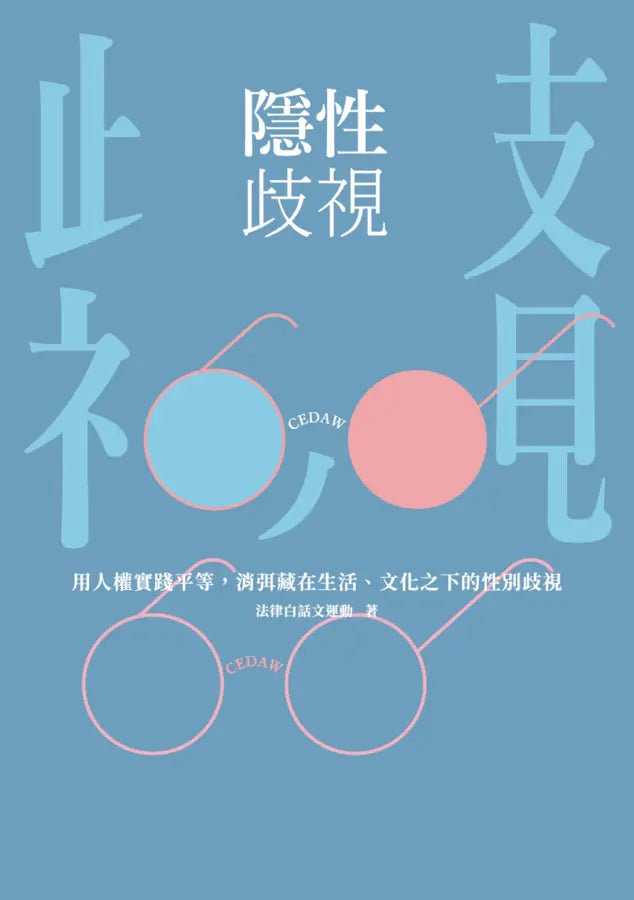

Subtle Discrimination: Using Human Rights to Practice Equality and Eliminate Gender Discrimination Hidden in Daily Life and Culture
Subtle Discrimination: Using Human Rights to Practice Equality and Eliminate Gender Discrimination Hidden in Daily Life and Culture
Couldn't load pickup availability
As human beings, are we truly equal?
Gender equality shouldn't just be a slogan, but how do we achieve it in real life?
This book helps you understand the "Convention on the Elimination of All Forms of Discrimination against Women" – an essential read for everyone striving for equality.
Let's implement equality, starting with each and every one of us!
In an age where awareness of gender equality is widespread, does gender-based discrimination still exist? Yes! Discrimination is still pervasive, hidden in various aspects of life, under the guise of social culture and customs. This is precisely the purpose of establishing the "Convention on the Elimination of All Forms of Discrimination against Women" (CEDAW). However, in what forms does this hidden discrimination exist in daily life? Why is it difficult to detect? And how can we make a difference?
What is discrimination? And what is the definition of "woman"?
In CEDAW, the term "discrimination against women" means any distinction, exclusion or restriction made on the basis of sex which has the effect or purpose of impairing or nullifying the recognition, enjoyment or exercise by women, irrespective of their marital status, on a basis of equality of men and women, of human rights and fundamental freedoms in the political, economic, social, cultural, civil or any other field. So the question arises, does "women" refer to biological females in a narrow sense, or does it also include psychological females in a broader sense?
I have bodily autonomy! But do I need my spouse's consent to decide whether or not to give birth?
According to the current "Genetic Health Act," if a married pregnant woman has a spouse and wishes to undergo an abortion "because pregnancy or childbirth will affect her psychological health or family life," she must obtain her spouse's consent. Not only that, in Taiwan, Article 288 of the Criminal Code still stipulates that a pregnant woman who has an abortion commits a crime and faces criminal liability, unless she meets the requirements of the "Genetic Health Act" to constitute an "exception where abortion is permitted." In the struggle between the fetal right to life and a woman's autonomy, how should we continue the dialogue?
Isolated from religion: the stigma of menstruation
Without menstruation, there would be no birth of babies, no birth of you and me, yet understanding this fact often does little to alleviate prejudice. Regarding the issue of discrimination triggered by menstruation, in many countries (especially in rural areas, such as the mountainous regions of Nepal), girls and women during their periods are often not allowed to go to school, work, visit temples to offer incense, or participate in important family rituals. In even more extreme cases, they are isolated, either by a marked line or a hut, confined to a limited space until the menstrual bleeding stops.
What is masculinity? Gender stereotypes under social prejudice
"Boys don't cry!" Recently, "toxic masculinity" has become a popular term, but what exactly is toxic masculinity, where does it come from, and why does it make everyone, regardless of gender, live such difficult lives? In contemporary Taiwanese society, what kind of gender temperament defines a "real man" and a "good man," or a "real woman" and a "good woman"? Are these contemporary definitions toxic and in need of elimination?
Taiwan's diplomatic challenges are tough, but not as tough as the 10% female quota
Taiwan's first female diplomat, Chang Siao-Yue, holds several "female first" records in the Ministry of Foreign Affairs. The recent establishment of these records highlights the difficulties women faced in entering the diplomatic system in early days, and the rarity of being heavily reused within the system. Why was diplomacy long considered a male profession? What measures should the government take to promote gender equality and ensure that female diplomats can participate and succeed in diplomatic work on equal terms? What practical difficulties do female diplomats face when being posted abroad?
Whose home should we live in after marriage? How can property distribution be fair?
Why do women have to move into their husband's family home after marriage? Is a man who lives in his wife's home called "marrying into the wife's family" (入贅)? Furthermore, in Taiwan, is there a preference for sons over daughters in property distribution (e.g., parents preparing a house for their son)? The issue of gender inequality in property distribution involves not only personal family relationships but also reflects gender role stereotypes in the social structure. Besides laws and policies, how can individuals, families, and education change this mindset?
This book examines existing social phenomena in Taiwan, based on the articles of the "Convention on the Elimination of All Forms of Discrimination against Women," to review long-standing issues of gender discrimination in our country. It also introduces cases from other countries, creating space for discussion, and paving the way for the gradual realization of gender equality.