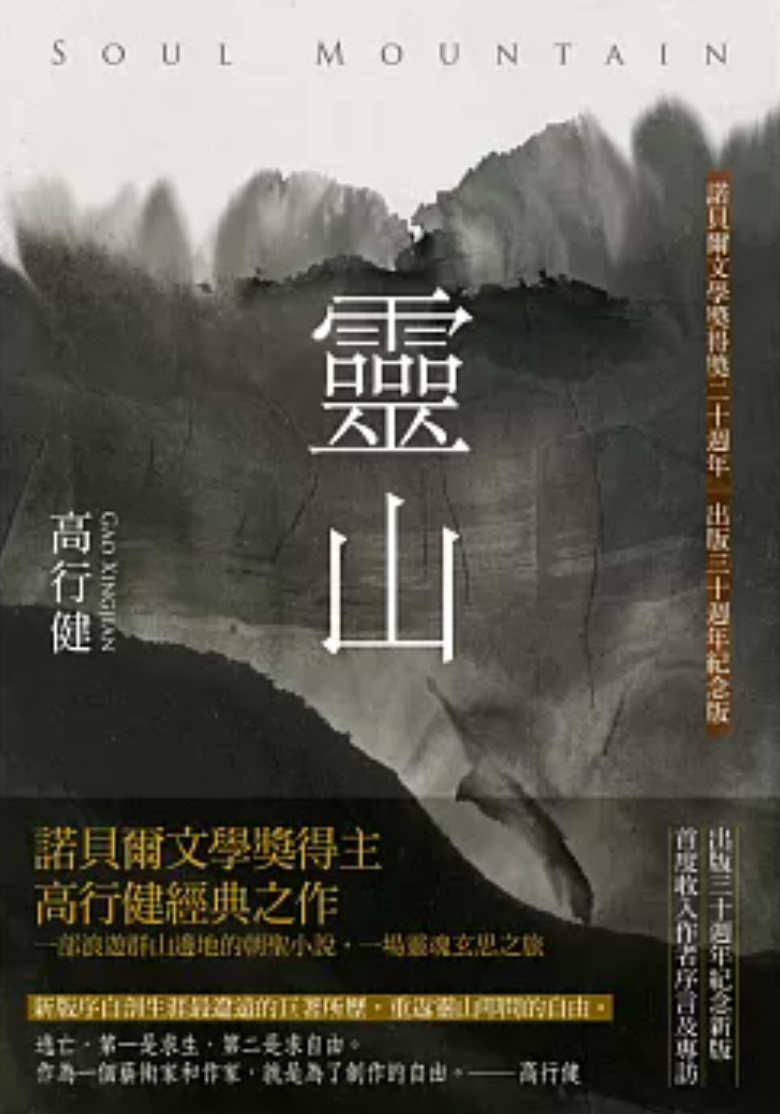

Spiritual Mountain
Spiritual Mountain
Couldn't load pickup availability
A masterpiece by Nobel laureate Gao Xingjian
A pilgrimage novel of wandering through mountains and borders, a philosophical journey of the soul
30th Anniversary New Edition
★Includes author's preface and interview for the first time★
Self-analysis of the most extensive magnum opus of his career, returning to Lingshan to question freedom.
Escape is, first, to survive, and second, to be free. For an artist and writer, it is for the freedom of creation.
──Gao Xingjian
Published for its 30th anniversary, "Soul Mountain" is considered Gao Xingjian's "greatest work" in his retrospective of his creative career. Not only did it take the longest to write, from China to France, but the novel also chronicles the author's wanderings along the Yangtze River basin in the 1980s, traveling to the Qinghai-Tibet Plateau, Sichuan, and Guizhou, covering over 10,000 kilometers through wild mountains and treacherous waters.
After being misdiagnosed with lung cancer, the protagonist of the novel leaves Beijing and travels upstream along the river. Along the way, he accidentally hears the name "Soul Mountain" and, with this in mind, arrives at Wuyi Town, the entrance to the mountain. His arduous journey thus takes on the meaning of a pilgrimage. Ostensibly, he travels as a writer, visiting villages, collecting folk songs, meeting singers and priests, delving into the lands of the Tibetan, Qiang, and Miao minorities where witchcraft and strange tales still circulate, and encountering another woman; in reality, through the interweaving perspectives of "I," "you," and "she," a journey of inner philosophical reflection unfolds.
The narrator declares: "In this long monologue, you are the object of my narration, a self listening to me; you are but my shadow." With its unique polyphonic narration, this novel blends new aesthetic expressions such as dramatic spoken language and also reveals intricate pathways of thought, as Gao Xingjian states, "opening channels to human consciousness and subconsciousness," and "pronouns are channels," using the practice of linguistic art to approach the landscape of the narrator's spiritual freedom from various angles.
The Swedish Academy's citation states: "Soul Mountain is not only a pilgrimage novel narrating the protagonist's journey, but also represents a process of reflection, with fiction and real life, fantasy and memory on either side of this reflective path. And the exploration of epistemological questions deepens progressively, to escape purpose and meaning."