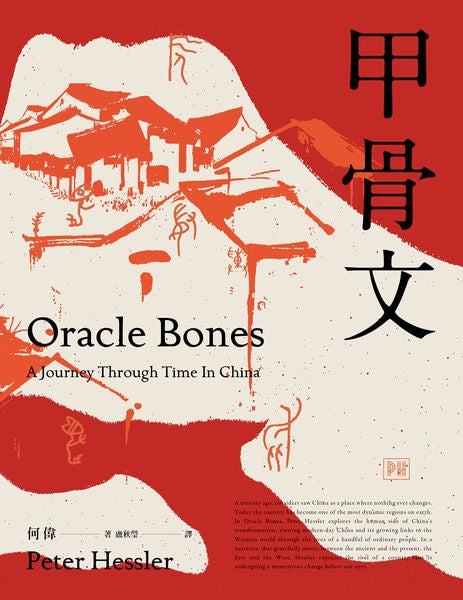

Oracle Bones (Peter Hessler's "China Trilogy," Vol. 2—Newly Revised Edition)
Oracle Bones (Peter Hessler's "China Trilogy," Vol. 2—Newly Revised Edition)
Couldn't load pickup availability
"Today, China seems to exist solely for Peter Hessler's writing!"
──The New York Times
If you want to understand 1990s China through one work, it's Peter Hessler's Oracle Bones.
Revisiting the non-fiction classic by The New Yorker journalist Peter Hessler
Uncovering the hidden, yet real, face of China beneath the media headlines!
======================
How do we evaluate China twenty years ago? China began its transformation in the 1990s, and the changes in its human landscape far surpassed those of the preceding two centuries. Most people chose to ignore the turbulent undercurrents beneath China's rise, but only one Western journalist decided to spend a decade investigating and telling the world what China had experienced and what it had lost.
In the hands of Peter Hessler, now hailed as a master of non-fiction, writing about China itself, and indeed the country's significance to the world, became a truly challenging endeavor. Twenty years ago, China was undergoing economic openness and rapid urban growth. Looking back at what changed and what remained unchanged in China, Oracle Bones stands as the most objective and profoundly moving documentary account.
"Before coming to China, I thought the past was over, that history was merely a linear progression of cause and effect.
But the longer I stayed in China, the less linear things became." ──Peter Hessler
In 1996, Peter Hessler entered China under the guise of the "Peace Corps," first teaching English in Fuling, Sichuan, and then moving to Beijing to serve as a columnist for The New Yorker. By 2006, Hessler completed this non-fiction classic, hailed as the finest writing on China—Oracle Bones—in a small apartment at the end of a narrow Beijing alley with no mailing address.
Oracle Bones had immense literary ambition. Hessler spent ten years investigating China, not only documenting his personal observations but also capturing the historical traces that had existed in the region for centuries. He wove these changes together through eyewitness accounts and archaeological investigations, then infused them with the perspective of a Western journalist, creating the magnificent scope of Oracle Bones. He allowed people to attest to China's transformation and ancient artifacts to bear witness to historical vicissitudes.
In this book, he specifically discusses ancient artifacts, such as bronze vessels from Yin Ruins and bronze heads from Sanxingdui. He interviewed Chinese, American, and Japanese experts to explore the discovery of ancient scripts, the Pinyin reform of Chinese characters, and the debate between traditional and simplified characters. He also resurrected the story of Chen Mengjia, an ancient script scholar who committed suicide during the Cultural Revolution, thereby intricately linking historical and cultural China with contemporary China. In other words, Hessler's journey in China has not only a realistic dimension but also a historical and metaphorical one, with the two intersecting and intertwining to form cracks like those on tortoise shells.
"To see the past from the perspective of the present, and to shape the present from the perspective of the past.
In China, the point isn't how things happened, but how they are remembered." ──Peter Hessler
China underwent reform and opening up in the 1990s, allowing people greater freedom of movement. Hessler had more opportunities to encounter those who had previously lived on the margins of survival, those who were originally destined to be "history-less." Now, for the first time, most Chinese people had control over their personal lives. Migrants made significant decisions: whether to leave the countryside, where to go, what kind of work to accept, and even if these choices were always difficult, they also reminded people of their own uniqueness.
These stories are vivid, unfolding before one's eyes: How did a North Korean defector steal Hessler's wallet in a small town on the Yalu River at the Sino-Korean border? Why did a Uyghur intellectual become entangled in Beijing's black market trade and eventually illegally immigrate to the United States? What did he see when he interviewed director Jiang Wen, who filmed "Devils on the Doorstep," in Xinjiang, Rebiya Kadeer's hometown, now in exile in the U.S.? In the instant city of Shenzhen, how did a girl from Sichuan outwit a Taiwanese businessman who kept a mistress, and find her own direction through inspiring radio programs? In Tiananmen Square, how did Falun Gong protesters, foreign tourists, and police play a cat-and-mouse game of escalating tactics? In Taiwan, what did Hessler observe about Sisy Chen and the elections? These stories weave together a compelling and truly moving tapestry of a journey through China.
In Oracle Bones, we see Peter Hessler observing as an outsider journalist. He befriends ordinary people, farmers, factory girls, Uyghur merchants, and small business owners from Wenzhou, Zhejiang, using their life stories to witness China's decade of change. He sheds external exoticizing views to present a series of captivating and bewildered, chaotic yet hopeful, contemporary Chinese scenes. From Beijing to Henan, from the Northeast to Xinjiang, from Wenzhou to Shenzhen, and even to Taiwan, the China depicted in Hessler's writing is more authentic and emotional than the real China.