
Sample 25: Archives Diary
Sample 25: Archives Diary
Couldn't load pickup availability
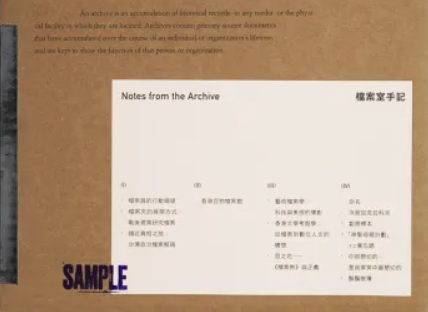
This issue, themed "Archives," introduces local archival management and research practices, analyzing the application of archives in different fields. In dark times, we need even more to understand the use of archives, and to know how to collect and read them.
|Upcoming Highlights|
❒ Document I|Archivist's Action Plan
In 2017, with the release of the documentary "Vanished Archives," Hong Kong once again saw a "fever for archives." This included the "Vanished Archives Concern Group," the "1941 Hong Kong Battle Spatial History Research Project," and "Local Research Group," among other pages and organizations, which used archives as a medium for historical research or directly regarded archives as a research method to construct local political and cultural discourses. However, before examining how people interpret archives, the first question to ask is: who created and managed these archives?
❒ Document I|Unfolding the Archive Folder: Post-War Architectural Research Archives
Archives urgently await to be opened, researched, and interpreted. The "present" and future generated by liberated archives depend on how they are unfolded. Post-War Architectural Research Archives (FAAR) aims to tell historical stories and establish a cultural discourse on Hong Kong architecture by unfolding architectural archives.
❒ Document I|Journey Towards Truth: Decoding Taiwan's Political Archives
Having experienced the White Terror period, Taiwan has implemented various measures to promote transitional justice since democratization. Among these, the enactment of the "Archives Act" and the collection and disclosure of political archives over the past two decades aim to help outsiders gain a deeper understanding of the mechanisms of authoritarian rule. This article hopes to analyze the relationship between archives and justice, truth, and the future by examining the process of transitional justice and the opening of political archives in Taiwan, leading everyone on this journey towards truth that is "destined to be unattainable, but endlessly approachable."
❒ Document II|PROJECT: Hong Kong Museum of 100 Objects
This issue collaborates with the Hong Kong Museum of 100 Objects established by artist Eric Keung, briefly outlining the process and considerations for setting up a personal archive. Readers can collect items and build a unique private archive according to their own perspectives and needs.
❒ Document III|Records
Ah Tu, Li Wei-ting, and Chan Ka-long examine the value and function of archives from the fields of art, literature, and philosophy, respectively. Transforming memories into documents and capturing the world through writing is precisely for the purpose of having evidence for rereading in the future.
❒ Document IV|Creative Feature: Self-Made Database
Ho Yee, Cheung Yan-yee, Wong Ho-wai, Chan Wan-hung, Wong On-lam, and Cheung Chun-ming respectively collect and filter experiences, refining inventory from daily life. Before things disappear, before everything comes to light, we can quietly collect.