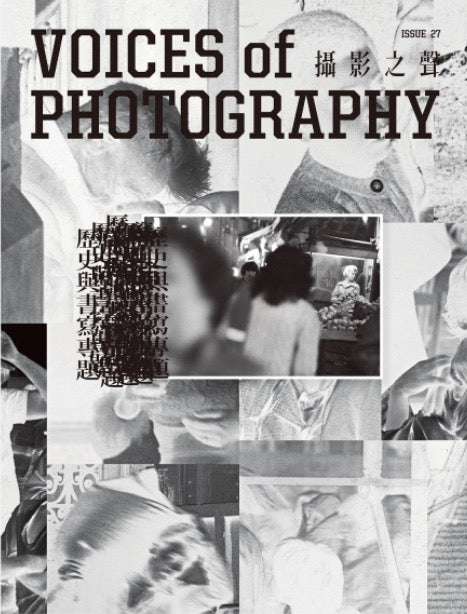

VOP Issue 27: Histories and Writings Issue
VOP Issue 27: Histories and Writings Issue
Couldn't load pickup availability
Since its inception, Voice of Photography has continuously focused on photographic writing, history, and cultural forms. In 2019, we organized a series of workshops on photographic historical narratives and held a forum on post-war East Asian photographic history at the "Taiwan Contemporary Culture Lab, C-LAB" in Taipei, inviting photography historians to participate and advance the discussion on photographic history research and photographic historical consciousness. This issue features special articles from the keynote speakers. These articles reflect on and reference photographic and historical discourse, highlighting the different concerns of Japanese, Korean, and Taiwanese researchers regarding the photographic journey in East Asia.
Among these, Ryuichi Kaneko re-positions the role of photographers' independent galleries in the development of Japanese photography in the 1970s, revealing how the non-mainstream creative脉动 is an important chapter that needs to be supplemented in the discourse of Japanese photographic history. Chia-Chi Chen explores the trend of Taiwanese amateur photographers participating in Japanese photography competitions in the 1960s and the potential influence of the competitive culture with Japanese photography magazines as a platform, showcasing an alternative civilian exchange field between post-war Taiwan and Japan's photography circles. Pyeong-Jong Park details the debates between realism and modernism in Korean photography after the end of Japanese colonial rule, clarifying the dialectic and introspection of post-war Korean understanding of photography. Masako Toda analyzes the photographic expressions in Japan in the 1950s, after breaking free from wartime suppression and gradually gaining liberation, influenced by the international "subjective photography" trend, showcasing the era's footprint in the progression of Japanese photographic aesthetics. Shih-Lun Chang examines post-war Taiwan's image manipulation, governance mechanisms, and the construction and interpretation issues of national photographic history itself, drawing from archival clues and political consciousness deeply embedded in Taiwanese society during the Cold War era.
Photography, through its integration with optics, chemistry, political sociology, cultural studies, and even semiotics and psychoanalysis, has continuously expanded, flowed, and been reconstructed, opening up space for exploring the ontology of photography. Pei-Chun Hsieh meticulously analyzes the process of photographic writing and interdisciplinary visual theories since the last century, outlining the development of photographic theories. This issue will initiate the first chapter of a series of discussions. Gu Zheng shares his personal experience of teaching photography history courses as a visiting scholar at Heidelberg University in Germany and offers critical reflections on the boundaries of photography history research. Leo Kin Keung Lai's series on the historical inference of photography's initial arrival in Hong Kong concludes, providing different historical evidence for the rise of the wet plate collodion process in Hong Kong in the 1850s.
In addition, this issue features a special interview with Chen Chuan-Hsing, publishing photographs and negatives he took in the late 1970s that have never been publicly shown for forty years, exploring the metaphorical meanings of images born from the intersection of silver halide and light, and his incessant contemplation on the essence of photography. At the same time, we also introduce Kao Chung-Li's new sound and projection installations, analyzing the ready-made audiovisual equipment and the technological philosophy behind his unique one-shot, longest "projector film" in history. The "Photography Book Production Scene" series enters the "Design" unit, with this issue featuring an interview with Japanese designer Daisuke Mori, who shares his delicate graphic design vocabulary.
Despite the challenges of maintaining publication, we have, over the years, strived to continue basic work such as data excavation and organization, and interview records, with limited resources, slowly developing a photographic culture and historical discourse centered on Taiwan and the Asian region. We thank our dear readers and friends for their support, allowing us to continue exploring the unknown galaxy of images in the new year.